Crooked, Chalky, Golden: The Case for Growing Quince
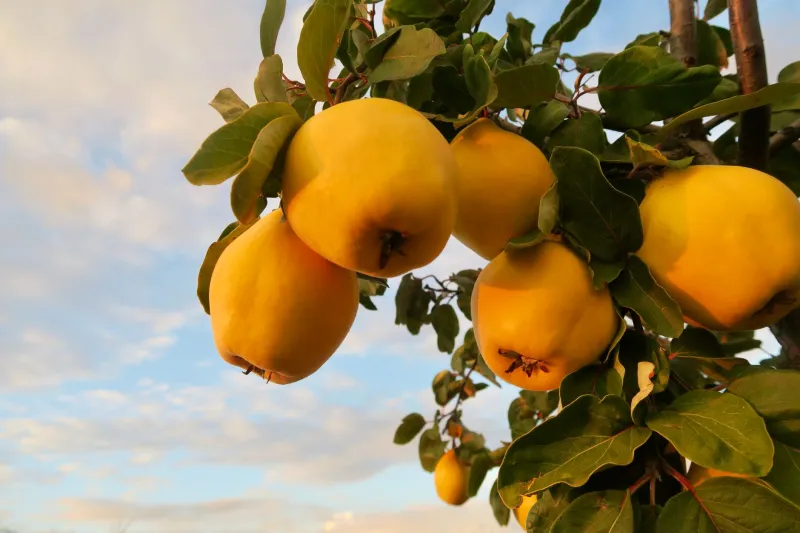
Every plot has room for one awkward character. Mine is a quince, planted eight years ago in a corner where the drain runs and nothing sensible ever thrived. It has rewarded me with roughly forty fruit in total. It has also given me the best thing on my Christmas table two years running, and that is the whole argument really.
Quinces are not generous in the way courgettes are generous, or apples, or the blasted kale. They are generous in the way a good friend who rarely rings is generous: you forget about them for eleven months, then a box arrives and it is extraordinary. If you can live with that rhythm, plant one.
The honest bit, before you dig
Let us not pretend. A quince in a UK garden is a gamble with a decent payout.
- Cropping is erratic. Some years you get a dozen fruit, some years three. Late frost, a wet June and a windy August can all take a bite out of the same harvest.
- Quince leaf blight loves our damp summers. Expect grey-brown patches on the leaves and a bit of dieback in a bad year; clear fallen leaves and prune it out promptly rather than admiring the problem.
- The fruit is hard as a brick when you pick it and stays that way for weeks. You cannot bite one. You cannot even slice one without a decent knife and some intent.
- Cooking takes hours. Not minutes. Hours. If you want a fast supper, this is not the fruit for you.
What you get in return is perfume you can smell from the next room, a tree that tolerates partial shade, and a fruit that carries sugar and acid in roughly equal measure — which is why it turns into such remarkable things.
Choosing a tree
Ask for a named variety rather than a seedling. Meeches Prolific is the reliable garden choice, cropping young and giving fruit that soften reasonably quickly. Vranja is bigger, later and more flavoursome, if you have the patience for a slightly sulkier tree. Champion is hardier for northern plots; Lescovac is often recommended where summers are short, because it ripens earlier.
Most quinces are self-fertile, so a single tree will usually crop, but two varieties planted within flying distance of the bees tend to set better. They are not small trees — a mature quince on Quince A rootstock will reach three to four metres with a similar spread. Give it room, or plan to keep it pruned to a goblet shape and accept a modest crop.
Planting and the first few years
Plant bare-root between November and March, on a mild day when the ground is not frozen or waterlogged. Quince dislikes sitting in wet soil far more than it dislikes a bit of shade, so fork a generous barrow-load of compost into the planting hole and check the drainage before you commit.
Stake it for the first three years, water it properly through its first two summers, and mulch in spring. Beyond that it mostly looks after itself. Prune in winter while dormant — thin out crowded growth, take out any dead or blighted wood, and shorten the long whippy shoots that will not carry fruit.
Fruit forms on short spurs on wood two years and older, so a hard renovation cut means a year or two off cropping. Be gentle with it.
Picking, ripening and storing
Harvest from late October into November, before the hardest frosts. A ripe quince turns from green to a dull gold and comes away with a gentle twist — if it needs a tug, leave it another week. Pick in dry weather and handle it like eggs; bruised fruit rot quickly.
You do not eat them straight off the tree. Lay the fruit out in a single layer in a cool room, or on a windowsill out of direct sun, and let them sit for two to four weeks. They soften slightly, the scent intensifies and the flesh becomes workable. A bowl of quinces in a hallway will perfume the whole house, which is a small free pleasure worth having.
They store for six to eight weeks like this if you check them regularly and remove any that start to soften at the wrong end. Do not wrap them in plastic.
The slow afternoon: membrillo
This is the recipe that justifies the tree. Membrillo, or quince paste, is a Spanish fixture on a cheese board, and it is the reason my quinces get handed out in December rather than eating into my patience in November.
Wash and roughly chop the fruit — skin, core and all. Put it in a heavy pan with a splash of water, cover and cook gently until it collapses, which will take the best part of an hour and will smell wonderful. Push it through a sieve or blitz it, then weigh the pulp.
Add an equal weight of granulated sugar and return it to a low heat. Now stir. And stir. It will spit at you, so use a long spoon and a tall pan. After an hour or so the mixture darkens to a deep amber, thickens, and starts to pull away from the sides of the pan. Test a dab on a cold plate: it should set firm rather than run.
Spread it into a lined tin, leave it overnight, then cut it into slabs or blocks and wrap them in greaseproof paper. It keeps for months in a cool cupboard and, wrapped with a scrap of ribbon, it is a better Christmas present than most of what I buy.
Poached halves, and other small kindnesses
For a simpler route, halve and core the fruit, then bake it cut-side up in a syrup of sugar, water, a vanilla pod and a star anise for an hour and a half at 160C, until a knife slides in without a fight. Serve warm with cream, or cold alongside the Christmas ham. The poaching liquor, reduced, is worth keeping in a jar for spooning over porridge.
Quince also makes a fierce, pink jelly if you simmer the peelings and cores with water and strain them overnight — an easy second use for the bits you were going to bin.
So, is it worth the space?
Yes, with conditions. Plant it where you can see it from the kitchen, give it room to be a proper tree, and expect to be underwhelmed for a few years. Then budget one slow afternoon in November, make the membrillo, and watch people at Christmas ask which cheese that is and where the paste came from.
That is the handshake. The tree takes its time, you take yours, and something very good ends up on a plate with a bit of Stilton and a glass of something. Grow it, cook it, share it — that is the whole deal.